trailer wire

Trailer wire is a durable, multi-conductor automotive cable designed to establish reliable electrical connections for lighting, signaling, and braking systems between a towing vehicle and a trailer.

Multi-Core Trailer Wire 

Trailer wire is designed to connect trailers to vehicles securely, ensuring reliable communication for lighting, ABS systems, and auxiliary functions. Engineered with stranded copper cores and color-coded PVC insulation, trailer cables resist abrasion, oil, gas, and moisture while simplifying correct identification and installation. Available in versatile configurations like 7-way trailer wire for complex setups, 4-way trailer wire for standard lighting, and 2-way trailer wire for basic connections. It can easily withstand high temperatures up to 176°F (80°C). Whether upgrading your trailer’s electrical system or sourcing “trailer wire nearby”, the range of trailer wire gauges and configurations from ZW Cable guarantees a precise fit.
Common Trailer Wire Types & Functions

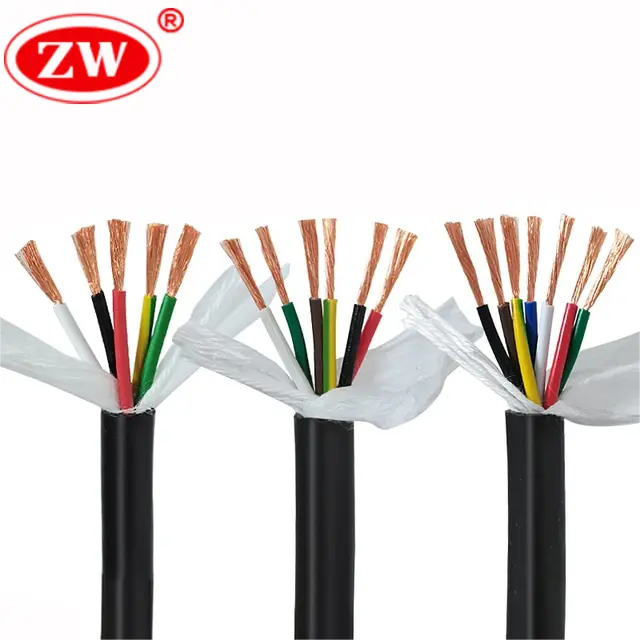
Choosing the correct cable configuration is the first step in ensuring system integrity. Below are the industry-standard specifications we adhere to for varying towing capacities.

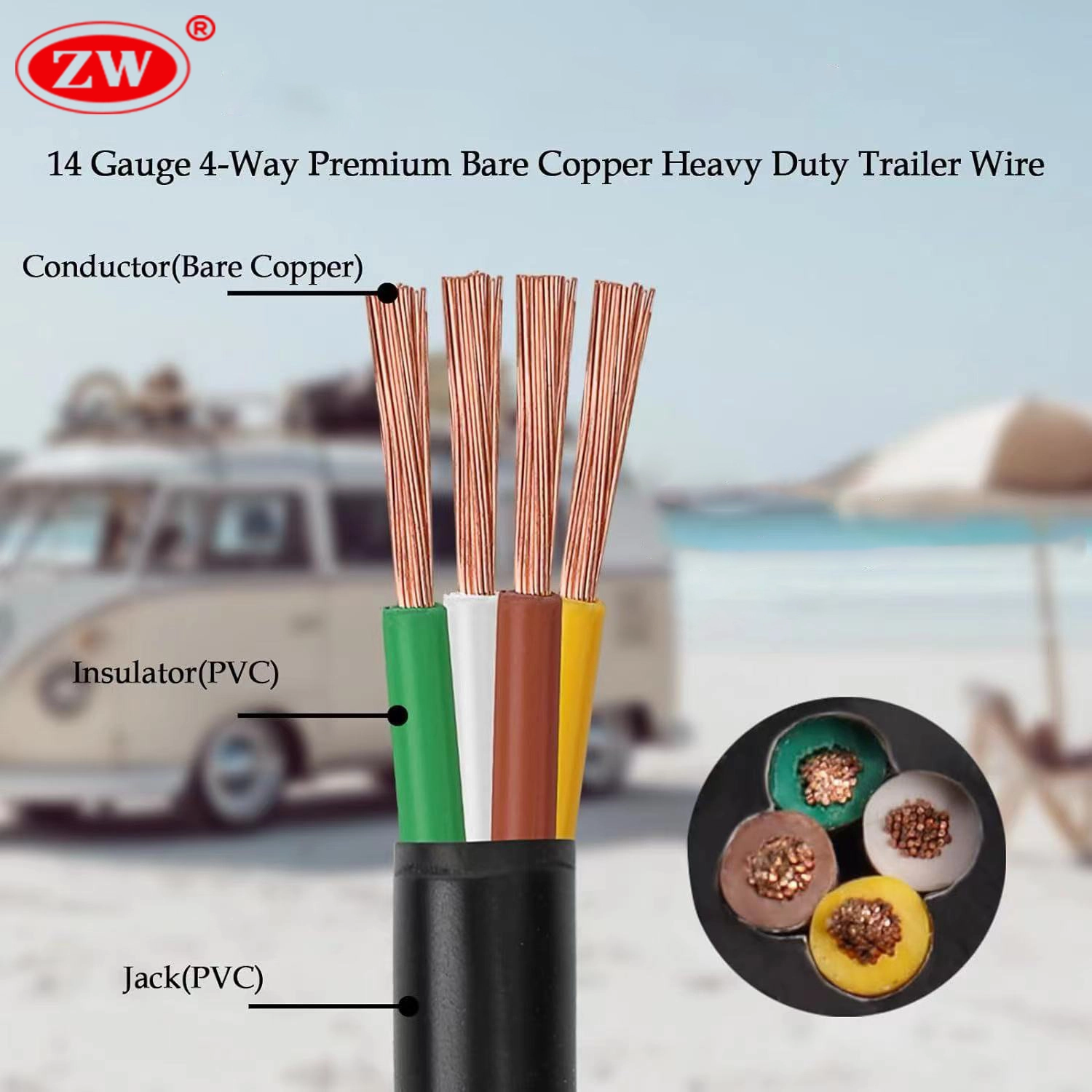
4-Way Trailer Wire: The industry standard for basic light-duty towing (Class I & II), commonly used on utility trailers, jet skis, and small watercraft. Typically manufactured as a flat, bonded profile, it carries the four essential lighting circuits: Ground, Tail/Marker Lights, Left Turn/Stop, and Right Turn/Stop.

5-Way Trailer Wire: This configuration builds on the standard 4-way design by adding a fifth conductor (typically Blue). It is predominantly used on boat trailers equipped with hydraulic surge brakes. The fifth wire signals a solenoid to disengage (lockout) the trailer brakes when the vehicle is reversing, preventing lockup when backing uphill.

6-Way Trailer Wire: Often found on horse trailers, goosenecks, and older agricultural equipment. This round-jacketed cable expands functionality to support Electric Brakes and a 12V Auxiliary feed (Hot Lead) for charging a small breakaway battery.

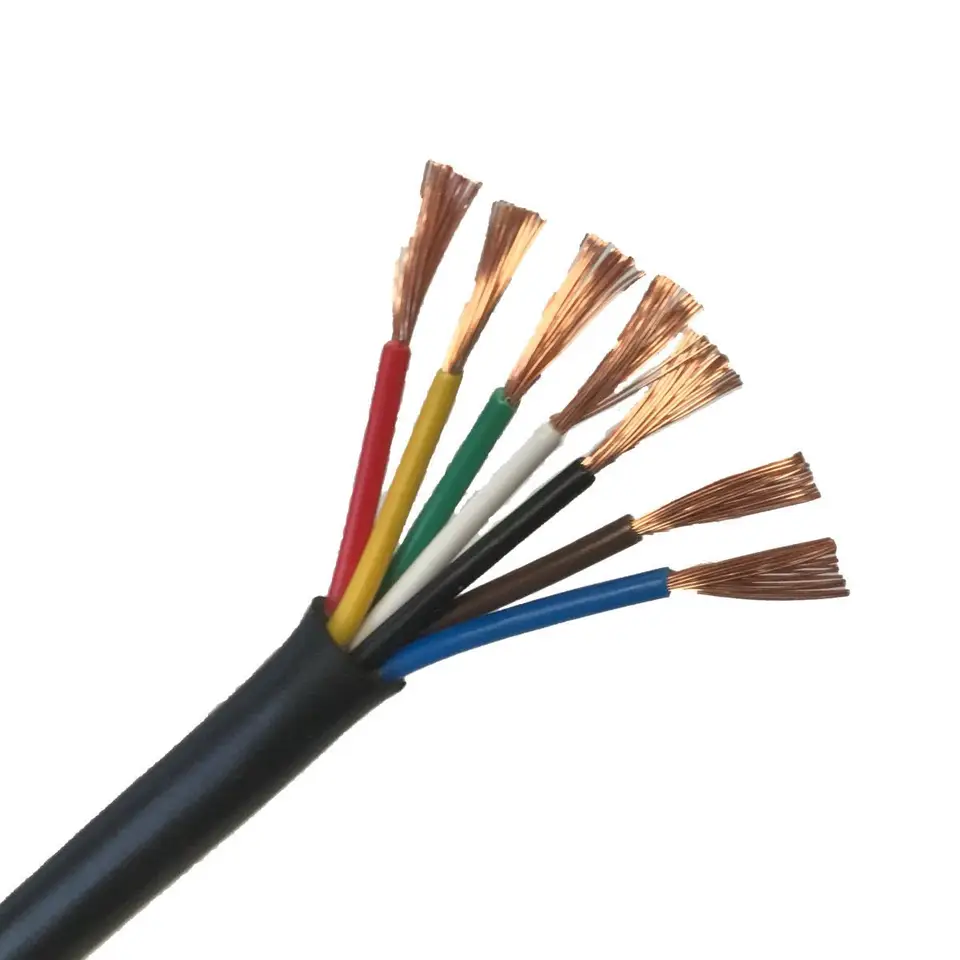
7-Way Trailer Wire: The definitive standard for heavy-duty RVs, commercial freight, and large agricultural trailers (Class III, IV, & V). This robust jacketed cable handles all lighting functions plus Electric Brakes, 12V Auxiliary Power (for battery charging), and Reverse Lights.

📘 Technical Deep Dive: Understanding Wire Types Not all wires are created equal. To understand the fundamental differences between primary wire types used in automotive and towing applications, refer to our guide: What Are the Different Types of Automotive Wires?

Can Your Cables Handle the Harsh Road?

A trailer wire hangs exposed under a chassis, blasted by everything the tires kick up. Standard “indoor” wire cannot survive this. Here is how we engineer for the road.

  1. Cold Weather Flexibility (-40°C)

We utilize a plasticized PVC compound formulated specifically for Cold Bend performance. Our wire remains pliable down to -40°C, ensuring the jacket flexes rather than fractures during winter maneuvers.

  1. Chemical & Road Salt Resistance

The outer sheath provides chemical inertness against common transport contaminants. This includes resistance to diesel fuel, hydraulic oil, and calcium chloride (road salts), which often degrades standard insulation.

  1. Abrasion Resistance

For jacketed cables, the extrusion wall thickness is optimized to resist mechanical wear caused by friction against the trailer frame, reducing the need for additional corrugated loom protection.

💡 Material Science: Insulation Matters Durability depends heavily on insulation ratings. For a technical comparison of high-temperature and abrasion-resistant wire standards (often critical in engine compartments vs. chassis), see our analysis: GXL vs. TXL Wire: Which is Right for You?

ZW Cable: Practical Solutions for Safer Towing

Beyond standard manufacturing, ZW Cable provides engineered connectivity solutions to solve specific, recurring transport failures.

Solution 1: 4-Way Flat Wire for Marine & Light Utility

The Challenge: Boat trailers face the ultimate test: repeated submersion in fresh or saltwater. Standard bonded wires often suffer from “zippering”—where the bonding adhesive fails, causing the wires to separate and tangle. Worse, water wicking up the wire leads to rapid corrosion.

The ZW Cable Solution: 

  • Product: Marine-Grade Bonded 4-Way Flat Wire.
  • Application Benefits: We use a proprietary thermal bonding process that ensures the four conductors stay fused together to prevent tangling during launch and retrieval, yet strip cleanly for installation.
  • Corrosion Defense: For premium marine OEMs, we offer Tinned Copper conductors. The tin plating acts as a shield, preventing the copper from reacting with saltwater. This ensures that the critical ground connection remains solid, even after years of dunking at the boat ramp.

Solution 2: 7-Way Trailer Wire for RVs & Heavy Haulers

The Challenge: Large RVs and car haulers suffer from Voltage Drop. If the wire gauge is uniform (e.g., all 14 AWG), the heavy current draw from electric brakes and battery charging can cause voltage sag, resulting in weak braking performance.

The ZW Cable Solution:

  • Product: Heavy-Duty 7-Way Round Cable.
  • Application Benefits: We utilize Optimized Gauge Configurations. Instead of a standard 7x14AWG, we manufacture cables with 10AWG or 12AWG for the Ground (White) and Brake (Blue) lines, while keeping 14AWG for the lower-power lighting circuits.
  • This “Hybrid Gauge” design minimizes resistance where it matters most, ensuring full braking power reaches the axles without the unnecessary weight and cost of oversizing the lighting wires. The thick outer jacket protects the entire bundle from stone chips and chassis rub.

Solution 3: TRVV Cable for Dynamic Moving Parts (Lift Gates & Sliders)

The Challenge: Modern logistics trailers are complex. They feature hydraulic lift gates, extendable chassis (slider trailers), and movable boom systems. Standard trailer wire is designed for static routing; it is stiff. When subjected to the constant bending, folding, and rolling of a lift gate or slider, the coarse copper strands fatigue and snap internally. This leads to equipment downtime and expensive roadside repairs.

The ZW Cable Solution:

  • Product: TRVV High-Flexibility Drag Chain Cable.
  • Application Benefits: Unlike standard Class 2 stranding, our TRVV cable uses Class 5 Super-Fine Copper Stranding combined with a specialized soft, oil-resistant PVC blend. Designed for millions of bending cycles (Drag Chain ready), it ensures uninterrupted power to hydraulic pumps and sliding axles, even after years of repetitive extending and retracting.

📖 Selection Guide Choosing the right wire thickness and material is crucial for safety. For a comprehensive look at selecting top-tier wiring for your specific trailer setup, read: The Guide to the Best Trailer Wire

Reference: Industry Standard Color Codes

Correct wiring is critical for safety and compliance. We adhere to standard color coding to ensure compatibility with towing vehicles.

Color Function Gauge Recommendation

(Heavy Duty)

White Ground 10 AWG / 12 AWG (Critical for return path)
Blue Electric Brakes 10 AWG / 12 AWG (High current draw)
Black Auxiliary Power (+12V) 10 AWG (Battery charging)
Brown Tail / Marker Lights 14 AWG
Green Right Turn / Stop 14 AWG
Yellow Left Turn / Stop 14 AWG
Purple Reverse / Backup 14 AWG

🔧 Installation Support Need help visualizing the wiring diagram or troubleshooting an installation? Visit our detailed technical resource on color codes and diagrams: Trailer Wire Color and Installation Guide

FAQ

Our standard GPT (General Purpose Thermoplastic) trailer wire is rated for -40°C to +85°C. This range covers the vast majority of chassis wiring applications. For high-heat areas (engine compartments), we recommend upgrading to SXL or GXL cross-linked polyethylene wire (rated to 125°C).
Trailer wiring operates exclusively on 12V DC (Direct Current) drawn from the tow vehicle's battery. This power flows through the connector plug to operate lights and electric brakes. AC power is never used for towing connections; it is only found in RVs when plugged into an external "shore power" source for appliances.
TRVV is a high-flexibility cable designed for moving parts like hydraulic lift gates and sliders. Its fine stranding allows it to withstand continuous bending without breaking internally.
Scroll to Top
Get in touch with us today and see how we can help you reach your goals!